
Trade Show Booth Las Vegas: Complete Guide to Design, AV Technology, and Exhibit Success
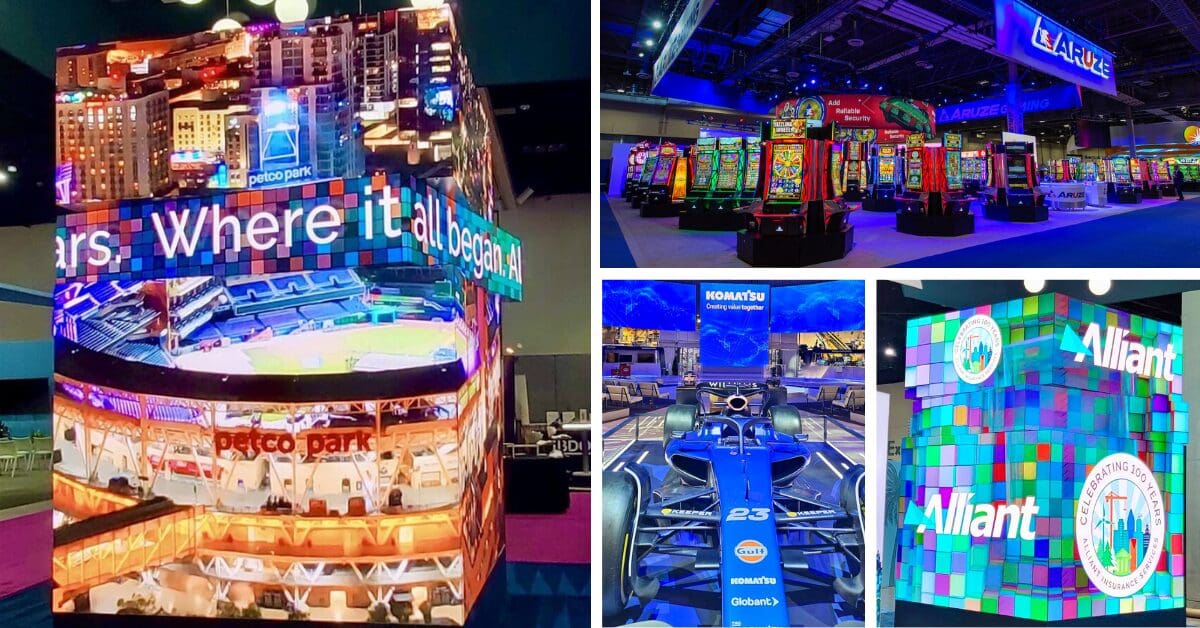
Planning a trade show booth in Las Vegas? Success requires more than an attractive exhibit design. From LED walls and interactive displays to installation logistics, skilled technicians, and venue requirements, every detail influences how effectively your booth captures attention, communicates your message, and engages attendees.
Las Vegas is one of the world’s most competitive trade show destinations. Whether you’re exhibiting at the Las Vegas Convention Center, The Venetian Expo, or Mandalay Bay Convention Center, you’re competing with hundreds or even thousands of other exhibitors for a limited amount of attendee attention.
For exhibit builders, that competition creates both a challenge and an opportunity.
The challenge is creating a booth that stands out without sacrificing functionality, budget, or reliability. The opportunity is using thoughtful design and advanced audiovisual (AV) technology to turn a trade show booth into a compelling brand experience.
This guide explains how to plan, design, equip, and support a successful Las Vegas trade show booth, including some of the practical considerations that rarely appear in traditional exhibit planning guides.
Why Is Las Vegas Such an Important Trade Show Destination?
Las Vegas has earned its reputation as a leading destination for conventions, exhibitions, and business events.
According to the Las Vegas Convention and Visitors Authority (LVCVA), Las Vegas welcomed approximately 6 million convention attendees in 2024, illustrating the scale of the city’s meetings and exhibitions industry.
The city hosts internationally recognized trade shows, including:
-
CES – consumer technology, digital innovation, and emerging products.
-
SEMA Show – automotive innovation, customization, and aftermarket products.
-
CONEXPO-CON/AGG – construction equipment, infrastructure, and industrial technology.
-
Global Gaming Expo (G2E) – gaming technology, casino operations, and entertainment.
-
Licensing Expo – licensing, entertainment properties, and consumer brands.
These events attract different audiences, but they share a common characteristic: exhibitors need to communicate their value quickly and effectively in visually competitive environments.
A technology company at CES may need to demonstrate complex software. An automotive exhibitor at SEMA may want to showcase product performance through dramatic video. A gaming company at G2E might need synchronized LED displays, lighting, and sound.
The best exhibit designs begin with an understanding of these differences.
What Makes a Successful Trade Show Booth in Las Vegas?
A successful Las Vegas trade show booth combines strong visual design, clear messaging, appropriate technology, and reliable execution.
The goal isn’t simply to attract as many people as possible. It’s to attract the right people and encourage meaningful engagement.
An effective exhibit should accomplish four things:
-
Capture attention: Give attendees a reason to notice the booth amid competing displays.
-
Communicate a message: Make it immediately clear what the exhibitor offers and why it matters.
-
Encourage interaction: Create opportunities for product demonstrations, conversations, and hands-on experiences.
-
Support business goals: Help generate qualified leads, strengthen relationships, introduce products, or reinforce brand recognition.
These goals should guide every design and technology decision.
For example, a booth focused on scheduled meetings may benefit from an elegant LED backdrop and private conversation areas. An exhibit promoting a new consumer product may need larger digital displays, demonstrations, and interactive experiences.
The right solution depends on the audience and the outcome the exhibitor wants to achieve.
How Do You Design an Exhibit That Stands Out in Las Vegas?
Imagine walking through a crowded exhibit hall at CES.
To your left, an exhibitor has installed an enormous LED wall displaying fast-moving graphics. To your right, another booth features a smaller screen showing a clear, compelling product demonstration.
Which one catches your attention?
Perhaps the larger display gets your initial glance. But if the smaller exhibit immediately shows you something relevant, that’s probably where you’ll stop.
This illustrates an important principle: visual impact and meaningful engagement aren’t the same thing.
The most effective trade show booth designs use visual elements to support a clear communication strategy.
Start with the message, not the equipment
Before selecting LED walls, monitors, lighting, or interactive technology, determine what attendees should understand about the exhibitor.
Can someone walking past the booth identify the company’s primary offering within a few seconds?
If not, adding more technology may simply create more visual noise.
Design for how people move
Exhibit builders should consider how attendees approach the booth, what they see from adjacent aisles, and where they naturally stop.
A large LED display positioned toward the back of an exhibit may create visual depth and draw visitors inward. A screen facing a major aisle can attract attention from a distance.
However, poorly positioned displays can create congestion, obstruct sightlines, or interfere with product demonstrations.
Balance technology with human interaction
Digital displays can attract attention, but they shouldn’t prevent visitors from engaging with booth staff.
Consider how the design accommodates conversations, product demonstrations, meeting areas, and visitor circulation.
The strongest exhibits use technology to initiate engagement and people to develop it.
How Can LED Walls Improve a Las Vegas Trade Show Booth?
Unlike conventional televisions, modular LED panels can be assembled into large displays or integrated into custom exhibit structures.
They can serve as brand backdrops, product demonstration surfaces, architectural elements, or high-impact displays designed to attract attendees from across the show floor.
Choose the right pixel pitch
Pixel pitch refers to the distance between adjacent LED pixels. Smaller pixel pitches generally provide sharper images at close viewing distances.
For many indoor trade show exhibits, pixel pitches between approximately 1.5 mm and 2.9 mm are worth evaluating.
However, the appropriate choice depends on viewing distance, content detail, display dimensions, and budget.
A wall showing dramatic product footage from 20 feet away may not require the same pixel density as a display showing detailed software demonstrations from five feet away.
Integrate LED technology into the exhibit architecture
Modular systems such as beMatrix LEDskin can be integrated into compatible exhibit frameworks.
This allows exhibit builders to incorporate digital displays into walls and other structural elements rather than treating them as separate equipment.
As a beMatrix bePartner, Total Show Technology works with exhibit builders to incorporate LED technology into custom and modular exhibit designs, helping align the visual experience with the exhibit’s architecture.
Plan the content alongside the display
A common mistake is finalizing the LED wall dimensions before determining what content will appear on the screen.
A wide, narrow LED wall may look striking in a rendering, but standard 16:9 video content may not fit properly.
Exhibit builders and content creators should coordinate display dimensions, pixel resolution, aspect ratio, and playback requirements early in the project.
For a deeper discussion, see our guide to beMatrix LED technology for trade show exhibits.
What Other AV Technology Should a Las Vegas Trade Show Booth Include?
LED walls aren’t the only audiovisual technology that can improve a trade show exhibit.
Depending on the exhibitor’s goals, a booth may benefit from several complementary technologies.
Interactive displays and touchscreens
Interactive displays allow visitors to explore products, compare features, navigate digital catalogs, or participate in demonstrations.
They’re particularly useful when an exhibitor offers multiple products or complex solutions that can’t easily be explained through static graphics.
For example, a software company might use an interactive touchscreen to guide visitors through different use cases, while a manufacturer could display detailed product configurations.
Professional audio systems
Audio can improve demonstrations, presentations, and product experiences.
However, trade show audio requires careful planning.
A sound system that’s too loud can interfere with conversations, create complaints from neighboring exhibitors, or violate show rules.
Directional speakers, controlled volume levels, and appropriate microphone systems can help deliver clear sound without overwhelming the surrounding environment.
Strategic exhibit lighting
Lighting influences how attendees perceive the entire booth.
It can highlight products, reinforce brand colors, illuminate architectural features, and direct attention toward important areas.
Lighting should complement LED displays rather than compete with them.
For example, excessive lighting directed toward a display may affect perceived contrast, while poorly positioned fixtures can create unwanted reflections on adjacent surfaces.
Live demonstrations and presentation technology
Some exhibitors need more than continuous video playback.
They may require live camera feeds, computer presentations, wireless microphones, video switching, or multiple synchronized displays.
These applications introduce additional requirements for signal management, processing, connectivity, and technical staffing.
The earlier these needs are identified, the easier they are to incorporate into the booth design.
What Should Exhibit Builders Know About Las Vegas Convention Venues?
Las Vegas convention venues differ in layout, infrastructure, service requirements, and operating procedures.
These differences can affect exhibit design, audiovisual installation, labor coordination, and project costs.
Las Vegas Convention Center
Its scale makes it suitable for large trade shows, but also introduces logistical considerations involving freight deliveries, installation schedules, exhibit hall access, and technical coordination.
Exhibit builders should review each show’s exhibitor service manual for labor rules, electrical services, hanging signs, booth construction restrictions, and approved contractors.
The Venetian Expo
The Venetian Expo hosts major industry events and offers extensive exhibition and meeting facilities.
One important consideration is the venue’s designated service providers. The Venetian identifies several exclusive services, including electrical, rigging, lighting, internet, and cleaning. It also notes that electrical service is not included in AV equipment pricing.
For exhibit builders, this means coordinating AV equipment rental with the venue’s service requirements before finalizing the budget.
Mandalay Bay Convention Center
The Mandalay Bay Convention Center hosts trade shows, corporate events, and industry conferences.
Its exhibit halls, meeting spaces, and event infrastructure support a wide variety of configurations.
As with other major Las Vegas venues, exhibit builders should confirm the applicable show-specific requirements for electrical service, rigging, material handling, installation labor, and audiovisual production.
Other Las Vegas conference and exhibit venues
Las Vegas also offers exhibition and meeting facilities at Caesars Palace, Wynn and Encore, ARIA, Fontainebleau, Resorts World, and other major resorts.
These properties can provide distinctive environments for executive meetings, smaller exhibits, brand activations, and specialized events.
However, hotel convention facilities may have different ceiling heights, freight access, electrical infrastructure, service agreements, and audiovisual requirements from traditional exhibition halls.
The lesson for exhibit builders: Never assume that an exhibit designed for one Las Vegas venue can be installed at another without adjustments.
What Are the Biggest Hidden Costs of a Las Vegas Trade Show Booth?
When exhibitors budget for a trade show booth, they often focus on exhibit design, fabrication, space rental, and equipment.
But several less-visible expenses can substantially affect the final cost.
Material handling and drayage
Drayage generally refers to moving exhibit materials from the receiving dock or advance warehouse to the booth, handling empty containers during the event, and returning freight for outbound shipment.
These charges are separate from many transportation and equipment rental costs.
Heavy LED systems, crates, and structural components can affect material handling expenses, making freight planning an important part of the AV budget.
Electrical service
LED walls, lighting systems, monitors, processors, and audio equipment all require power. Exhibitors may need to pay separately for electrical drops, distribution, labor, and other services.
For example, the Venetian Expo explicitly states that electrical service is ordered separately from audiovisual equipment.
An accurate AV estimate should identify the equipment’s power requirements and clarify who is responsible for ordering and paying for the necessary services.
Installation and dismantling labor
Trade show labor can involve multiple teams with different responsibilities.
The exhibit builder may handle structural installation while AV technicians assemble and configure the LED displays. Venue-designated contractors may be required for electrical connections or overhead rigging.
Labor rules and jurisdiction vary by venue and event, so responsibilities should be confirmed before move-in.
Overtime and schedule changes
A delayed freight delivery, unfinished booth structure, or last-minute content change can create additional labor costs.
If an AV crew arrives before the exhibit is ready, technicians may be forced to wait or return later.
This is why detailed installation sequencing matters.
Internet and connectivity
Interactive exhibits, cloud-based demonstrations, live streaming, and connected applications may require reliable internet access.
Convention-center connectivity can be expensive, and the appropriate service depends on the application.
For mission-critical demonstrations, consider whether a wired connection, dedicated service, or tested offline alternative is necessary.
Technical support during the show
An equipment rental quote doesn’t necessarily include a technician throughout the event.
Some exhibits need only installation and initial testing. Others require continuous monitoring, live presentation support, or rapid troubleshooting.
Exhibit builders should clarify support expectations before finalizing the AV agreement.
How Can Exhibit Builders Avoid Common AV Installation Problems?
Many audiovisual problems begin long before the exhibit reaches the show floor.
They often result from incomplete specifications, unclear responsibilities, or design decisions made without technical input.
Problem 1: The LED wall doesn’t fit the structure
A display may fit perfectly in a rendering but encounter problems during installation because of cabinet dimensions, structural tolerances, mounting requirements, or insufficient service access.
Solution: Confirm the exact LED panel dimensions, mounting system, weight, and access requirements before fabrication begins.
Problem 2: The content doesn’t fit the screen
A custom LED wall may have an unusual aspect ratio that doesn’t match standard video files.
Solution: Provide content creators with the actual pixel dimensions and technical specifications before they begin production.
Problem 3: The booth isn’t ready for AV installation
LED installation may depend on flooring, structural framing, electrical access, or other components being completed first.
Solution: Develop a coordinated installation schedule that identifies dependencies among exhibit construction, AV installation, electrical services, and testing.
Problem 4: Technical responsibilities aren’t clear
The exhibit builder, AV provider, general service contractor, and venue may each have responsibilities that overlap.
Solution: Establish a responsibility matrix identifying who supplies equipment, installs structures, orders power, manages rigging, tests content, and provides show-site support.
Problem 5: There’s no contingency plan
Even well-planned installations can experience equipment failures, damaged cables, unexpected signal issues, or last-minute content changes.
Solution: Discuss spare equipment, backup playback options, technical escalation procedures, and on-site support before the show.
Why Does Experienced AV Staffing Matter at Las Vegas Trade Shows?
Advanced technology is only as effective as the people responsible for installing and operating it.
A professional AV technician does more than connect equipment.
Experienced technicians understand signal distribution, video processing, display configuration, color calibration, audio systems, and the practical demands of live events.
They can also recognize problems before those problems affect the exhibitor.
For example, an experienced LED technician may identify a mismatch between the content resolution and display configuration during testing, rather than discovering it when the show opens.
Similarly, a knowledgeable AV production manager can coordinate with exhibit builders and venue contractors to reduce installation delays.
What should you look for in an AV partner?
Exhibit builders should evaluate prospective AV providers based on technical capabilities, relevant trade show experience, equipment quality, staffing, and support.
Ask whether the provider can:
-
Review exhibit drawings and identify AV integration requirements.
-
Recommend equipment based on the booth’s goals and physical constraints.
-
Provide content specifications and technical guidance.
-
Coordinate installation schedules with other contractors.
-
Supply experienced technicians familiar with trade show environments.
-
Support equipment testing, troubleshooting, and show operations.
-
Establish backup plans for critical equipment and presentations.
A provider’s ability to anticipate challenges is often as valuable as the equipment itself.
How Far in Advance Should You Plan for a Las Vegas Trade Show?
Planning timelines vary depending on exhibit size, complexity, and the event.
A straightforward booth using standard rental equipment may require less preparation than a custom exhibit featuring integrated LED walls, interactive technology, and overhead structures.
The following schedule provides a general planning framework.
|
Timing |
Recommended activities |
|---|---|
|
4–6 months before |
Define goals, audience, booth concept, and preliminary budget |
|
3–4 months before |
Develop exhibit design, identify AV requirements, and coordinate vendors |
|
2–3 months before |
Confirm equipment, structural specifications, content needs, and installation plans |
|
4–8 weeks before |
Finalize drawings, service orders, staffing, and content production |
|
1–3 weeks before |
Test content, verify equipment requirements, and confirm logistics |
|
Move-in |
Install, configure, calibrate, and test all AV systems |
|
Show days |
Monitor performance, support presentations, and troubleshoot as needed |
|
Move-out |
Coordinate equipment removal and dismantling |
These are planning recommendations rather than universal deadlines. Always use the show’s official service manual to determine actual submission dates and ordering requirements.
For complex exhibits, earlier coordination can help reduce last-minute design changes and unexpected expenses.
Should You Rent or Buy AV Equipment for a Las Vegas Trade Show Booth?
For many exhibitors, renting AV equipment offers greater flexibility than purchasing it.
Rentals allow exhibit builders to select equipment based on the specific booth design, venue, and event goals.
For example, an exhibitor might use a large LED wall at CES, smaller interactive displays at a regional conference, and a combination of monitors and presentation technology at another event.
Renting allows the AV configuration to change without requiring the exhibitor to own and maintain every piece of equipment.
Purchasing may make sense for organizations with frequent, repeatable exhibit configurations and the infrastructure to manage storage, transportation, maintenance, and technical operations.
When comparing rental and ownership costs, consider equipment depreciation, shipping, maintenance, storage, technical staffing, and the potential need to upgrade technology.
For exhibit builders managing multiple clients, working with an established AV rental partner can provide access to different technologies without maintaining a large inventory.
How Can You Measure the Success of Your Exhibit?
A visually impressive booth doesn’t necessarily deliver a strong return on investment.
The most useful performance measures depend on the exhibitor’s goals.
For example, an exhibitor launching a new product may prioritize demonstrations and qualified leads. A company attending an industry conference may focus on meetings with existing customers and prospective partners.
Useful metrics include:
|
Goal |
Potential measurement |
|---|---|
|
Attract attention |
Booth traffic and visitor engagement |
|
Generate leads |
Number and quality of qualified leads |
|
Demonstrate products |
Completed demonstrations and follow-up requests |
|
Build relationships |
Scheduled and completed meetings |
|
Increase brand awareness |
Brand recall, surveys, and post-event engagement |
|
Support sales |
Pipeline opportunities and subsequent conversions |
AV technology can contribute to these outcomes by helping exhibitors attract attention, explain products, and create opportunities for interaction.
However, measuring results requires more than counting how many people stop to watch a video.
A smaller number of highly qualified visitors may deliver more value than a large crowd with little interest in the exhibitor’s offerings.
Exhibit builders can help their clients think through these goals before making design and technology decisions.
How Can Total Show Technology Help with a Las Vegas Trade Show Booth?
With 30 years of experience in the audiovisual production industry, Total Show Technology helps exhibit builders, exhibitors, and meeting planners navigate the technical demands of Las Vegas trade shows.
TST provides advanced audiovisual technology, LED walls, interactive displays, lighting, audio equipment, and skilled technical staffing for trade shows, conferences, and corporate events.
As a beMatrix bePartner, TST also works with exhibit builders to integrate modular LED technology into custom exhibit structures.
But equipment is only part of the equation.
Successful AV production requires thoughtful planning, coordination with exhibit builders, attention to venue requirements, and reliable support during installation and throughout the event.
Whether an exhibitor needs a large LED display to attract attention from across the aisle or a more complex AV configuration supporting demonstrations and presentations, TST can help identify practical solutions that fit the exhibit’s design and communication goals.
The goal is straightforward: help exhibit builders deliver visually compelling, technically reliable exhibits that meet their clients’ expectations.
Frequently Asked Questions About Las Vegas Trade Show Booths
How much does a trade show booth cost in Las Vegas?
The cost of a Las Vegas trade show booth depends on its size, design, materials, technology, and event requirements. Expenses may include booth space, exhibit fabrication or rental, AV equipment, graphics, transportation, material handling, electrical service, labor, and technical support. Request an itemized estimate that includes both exhibit construction and show-site services.
What is the best AV technology for a Las Vegas trade show booth?
The best AV technology depends on the exhibitor’s goals. LED walls are effective for large-format visuals and brand messaging. Interactive displays support product exploration, while professional audio and lighting can improve presentations and demonstrations. Many exhibits benefit from a combination of technologies.
How do I make my trade show booth stand out in Las Vegas?
Start with a clear message and a design that supports the exhibitor’s goals. Use compelling visuals, strategic lighting, and appropriate digital displays to attract attention. Provide opportunities for interaction and ensure the exhibit is easy to navigate. Effective booth design balances visual impact with meaningful engagement.
Can I bring my own AV company to a Las Vegas trade show?
Often, yes, but the rules depend on the venue and event. Certain services, such as electrical work, rigging, and internet connectivity, may be restricted to designated providers. For example, The Venetian Expo identifies several exclusive service categories. Review the official exhibitor service manual before contracting with outside providers.
What size LED wall is best for a trade show booth?
The appropriate size depends on booth dimensions, viewing distance, content, and the intended role of the display. A smaller booth may benefit from a compact integrated LED wall, while a large island exhibit may accommodate expansive video surfaces. Bigger isn’t always better; the display should complement the booth’s design and message.
What is the difference between an exhibit builder and an AV production company?
An exhibit builder typically designs, fabricates, and installs the physical trade show booth. An AV production company provides and supports technologies such as LED walls, monitors, audio systems, lighting, and video processing. The two work together to integrate technology into the exhibit.
Do I need an AV technician at my trade show booth?
That depends on the complexity of the equipment and how it will be used. A simple monitor playing prerecorded content may require only installation and testing. A booth featuring multiple LED walls, live demonstrations, presentations, or interactive systems may benefit from dedicated on-site technical support.
How early should I book AV equipment for a Las Vegas trade show?
Begin coordinating AV requirements during the exhibit design phase. For larger or technically complex booths, planning several months ahead helps ensure equipment availability and sufficient time for structural coordination, content preparation, and installation scheduling.
What are the most common trade show AV mistakes?
Common mistakes include selecting equipment before defining communication goals, overlooking content specifications, underestimating power and structural requirements, failing to coordinate installation schedules, and not arranging adequate technical support.
Can LED walls be integrated into beMatrix trade show booths?
Yes. beMatrix LEDskin technology is designed to integrate into compatible beMatrix exhibit structures. This allows exhibit builders to incorporate digital displays into modular booth designs while maintaining a cohesive architectural appearance.
Make Your Las Vegas Trade Show Booth Count
Las Vegas offers tremendous opportunities for exhibitors, but standing out on a crowded trade show floor takes more than an attractive booth.
Successful exhibits combine thoughtful design, clear messaging, advanced technology, and dependable execution. For exhibit builders, that means considering audiovisual technology early in the design process, understanding venue requirements, coordinating with experienced technical partners, and planning for the practical realities of installation and show operations.
The best trade show booths don’t simply attract attention. They communicate something meaningful, encourage interaction, and help exhibitors achieve their business goals.
Total Show Technology brings together advanced AV equipment, experienced technicians, and decades of trade show production experience to help exhibit builders deliver outstanding results in Las Vegas and beyond.
As you plan your next Las Vegas trade show booth, consider how can the right combination of design, technology, and technical expertise help your exhibit stand out from the crowd. TST is ready to help.