
Event Technology: From “Wow” Factor to Strategic Advantage
Event technology in 2026 blends data, immersive visuals, AI, and human-centered design to create measurable, memorable, and scalable experiences worldwide.
Event technology is no longer about novelty. In 2026, it is about intention, integration, and impact.
Attendees are more selective with their time than ever before. Exhibitors and event owners are under pressure to justify budgets with real outcomes. And planners are expected to deliver experiences that feel both immersive and intelligent. The result is a clear shift: event technology has become a strategic business tool, not just a production line item.
Below, we explore how event technology is evolving in 2026—and how organizations that use it well are gaining a measurable edge.
1. Experience Is Table Stakes. Intelligence Is the Differentiator.
Immersive environments are no longer a competitive advantage—they are the baseline expectation. By 2026, most attendees assume events will include large-format visuals, polished sound, dynamic lighting, and interactive elements. What truly separates leading events from forgettable ones is not how immersive they are, but how intelligently that immersion is designed and deployed.
In other words, experience alone is no longer enough. Intelligence is what turns experience into impact.
High-performing events in 2026 use event technology deliberately, with clear intent behind every design and production decision. Rather than deploying technology for novelty’s sake, they ask: What behavior are we trying to encourage? What story are we telling? What outcome matters most?
How Intelligent Event Technology Shows Up in Practice
In the most effective events, technology is orchestrated to support both attendee experience and organizer decision-making:
-
Guiding attendee flow and behavior
Intelligent use of video, lighting, audio cues, and spatial design subtly directs how people move through an environment. LED content shifts signal session transitions. Lighting draws attention to key zones. Audio reinforcement encourages dwell time in high-value areas. The result is smoother traffic flow, less congestion, and more intentional engagement. -
Adapting content in real time
In 2026, static content feels outdated. Advanced event technology allows teams to adjust messaging on the fly—swapping visuals, modifying schedules, or highlighting different calls to action based on attendance patterns, session popularity, or time of day. This agility ensures content remains relevant to the audience in front of it, not just the one it was originally planned for. -
Capturing meaningful engagement data
Intelligent experiences generate insight. By integrating polling tools, badge tracking, session analytics, and post-event feedback, planners can understand not just who showed up, but what resonated. Which content drove longer engagement? Which spaces underperformed? Which messages converted interest into action? This data becomes the foundation for smarter future events. -
Tying experience design directly to business goals
The most mature use of event technology connects production choices to outcomes such as lead quality, brand recall, training effectiveness, or internal alignment. Technology decisions are measured against KPIs—not aesthetics alone—ensuring budgets are spent where they deliver the most value.
From Isolated Gear to Integrated Experience Systems
This shift requires moving beyond isolated technology choices—adding a screen here or a lighting effect there—and toward integrated experience systems.
In an integrated system:
-
Video, audio, lighting, scenic design, and content strategy are planned together
-
Technology platforms share data instead of operating in silos
-
Production supports narrative flow rather than competing for attention
-
Every technical element reinforces the same strategic story
When event technology functions as a unified ecosystem, the experience feels effortless to attendees—but is anything but accidental behind the scenes.
In 2026, the events that stand out are not the loudest or flashiest. They are the ones that feel purposeful, responsive, and intelligently designed from the first impression to the final follow-up.
2. LED Technology Evolves Into Architectural Storytelling
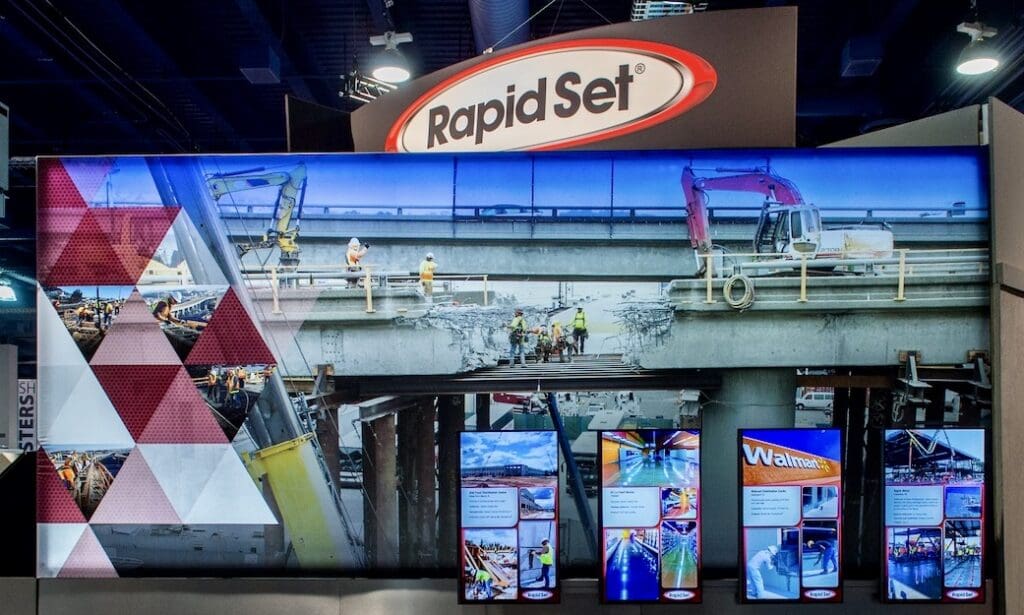
LED video walls are no longer just “big screens mounted to truss.” In 2026, LED is architectural, modular, and deeply narrative-driven. The most effective event environments use LED as a building material, not a bolt-on display—integrated directly into the structure of booths, stages, and branded environments.
This evolution reflects a broader shift in event technology: visual storytelling now begins with the physical space itself.
LED as Structure, Not Surface
Advanced systems such as beMatrix LEDskin allow event teams to embed LED directly into booth architecture, eliminating the visual and physical separation between structure and content. Rather than designing a booth and thendeciding where to place screens, planners and designers can now think holistically—where the architecture is the media.
With modular LED systems, teams can:
-
Build LED walls directly into beMatrix frames
-
Create curved, angled, inner- and outer-corner displays
-
Design wraparound and semi-enclosed LED environments
-
Deliver immersive visuals without expanding booth footprint
This structural integration results in cleaner sightlines, stronger brand presence, and a more cohesive attendee experience—especially in crowded exhibit halls where attention is fiercely contested.
Storytelling at Scale, Not Just Size
The real innovation in LED technology isn’t just resolution or brightness—it’s storytelling flexibility.
In 2026, LED content is increasingly designed as a living narrative:
-
Messaging changes throughout the day
-
Visuals adapt to different audience segments
-
Content shifts based on demos, presentations, or live moments
-
Campaigns evolve across multi-day shows
Instead of a single looping video, LED becomes a responsive storytelling canvas—one that supports product launches, thought leadership, demos, and brand moments within the same footprint.
When paired with intentional content strategy, LED doesn’t just attract attention—it holds it.
Maximizing Event Technology Impact While Protecting ROI
Another defining advantage of modular LED systems is financial efficiency. In an era of tighter budgets and higher expectations, exhibitors are prioritizing event technology that delivers long-term value.
Modern LED systems allow organizations to:
-
Reconfigure the same LED assets across multiple booth sizes and layouts
-
Repurpose content and hardware for different events and audiences
-
Reduce reliance on printed graphics and one-off scenic builds
-
Scale up or down without starting from scratch
This modularity transforms LED from a single-event expense into a reusable strategic asset—one that improves ROI while maintaining creative flexibility.
From Static Graphics to Living Brand Environments
For exhibitors, the implications are significant. Static graphics and fixed messaging are rapidly giving way to dynamic, adaptable brand environments. LED architecture enables teams to test messages, highlight different products, or support regional campaigns—all within the same physical structure.
In 2026, the most compelling booths are not just visually impressive—they are responsive, flexible, and story-driven.
LED technology has moved beyond spectacle. It has become one of the most powerful tools in event technology for shaping how brands are seen, experienced, and remembered—turning physical space into an immersive narrative that draws attendees in from across the show floor and keeps them engaged once they arrive.
3. Data-driven Event Technology Becomes Non-Negotiable
In 2026, events are expected to generate insights—not just impressions.
Modern event technology stacks commonly include:
-
RFID or badge-based tracking
-
Session polling and live feedback tools
-
Heat mapping for booth engagement
-
Post-event surveys tied to CRM and marketing automation systems
The value isn’t in collecting data—it’s in connecting it.
Smart planners and exhibitors use event data to:
-
Identify which content actually resonates
-
Refine booth layouts and staffing strategies
-
Prove ROI to internal stakeholders
-
Improve future events with evidence, not assumptions
Event technology now supports a continuous improvement loop, turning live experiences into long-term strategic assets.
4. AI Quietly Reshapes Event Production and Personalization
Artificial intelligence is no longer flashy—it has the potential to be embedded. While the potential has yet to be fully realized, 2026 looks to be the year that AI in events becomes more common.
In 2026, AI-driven event technology will increasingly be used to:
-
Personalize content recommendations in event apps
-
Optimize show schedules and staffing
-
Analyze attendee sentiment from surveys and social engagement
-
Assist with real-time content adjustments and messaging
The most effective uses of AI are invisible to attendees but invaluable to planners. AI can help teams do more with leaner resources while delivering experiences that feel curated rather than generic.
5. Hybrid Is No Longer a Format—It’s a Layer
The hybrid debate is over. In 2026, most events include digital extensions, even if they are primarily in-person.
Examples include:
-
Livestreamed keynote moments
-
On-demand session libraries
-
Social-first content capture
-
Remote stakeholder access for sales or leadership teams
Event technology now supports before, during, and after engagement—extending the lifespan of an event well beyond the show floor.
6. Budget Discipline Meets Creative Engineering
-
One of the most important—and often overlooked—shifts in event technology is financial maturity.
In 2026, successful event teams are no longer impressed by the largest gear lists or the most expensive configurations. Instead, they are focused on making smart, intentional investments that align technology choices with measurable outcomes. The question is no longer “What can we add?” but “What actually moves the needle?”
Smarter Event Technology Starts With Strategic Restraint
Experienced planners and exhibitors understand that over-specifying technology often creates more problems than it solves—driving up costs, increasing complexity, and introducing unnecessary points of failure.
High-performing teams now prioritize:
-
Modular, reusable systems that can be reconfigured across different booth sizes, venues, and show formats
-
Multi-show asset strategies that spread investment across an entire event calendar rather than a single activation
-
Content-first design decisions where technology serves the story, not the other way around
-
Flexible infrastructure that scales up or down depending on audience size, room configuration, and program goals
This approach delivers better consistency, lower long-term costs, and greater creative freedom—without sacrificing impact.
Creative Engineering: Doing More With What Matters Most
Budget discipline does not mean playing it safe. In fact, some of the most compelling event environments in 2026 are the result of creative engineering—finding innovative ways to maximize effect within real-world constraints.
Creative engineering focuses on:
-
Leveraging technology across multiple touchpoints instead of concentrating spend in one area
-
Designing systems that support multiple use cases (keynotes, demos, networking, content capture)
-
Using content, lighting, and scenic integration to elevate simpler technical builds
-
Eliminating redundancy while preserving flexibility and reliability
The result is event technology that feels polished, immersive, and intentional—without unnecessary excess.
Why the Right AV Production Partner Matters More Than Ever
This level of efficiency and sophistication requires more than access to equipment. It requires an AV production partner who understands both the technical landscape and the business realities behind every event.
Total Show Technology helps clients:
-
Avoid investing in expensive technology that sounds impressive but doesn’t serve a clear purpose
-
Identify where innovation will have the greatest audience impact
-
Engineer creative, cost-effective solutions tailored to specific goals and constraints
-
Balance cutting-edge design with proven, reliable systems
-
Build intelligent AV environments that support experience and ROI
Rather than defaulting to a standard package, the right partner acts as a strategic advisor—helping teams make informed decisions, prioritize wisely, and protect budgets while still delivering standout experiences.
The New Standard for Event Technology Investment
In 2026, the most successful events are not defined by how much technology they deploy, but by how well that technology is used.
Budget discipline and creative engineering go hand in hand. When paired with an experienced AV production partner, they enable organizations to design event technology ecosystems that are scalable, sustainable, and impactful—ensuring every dollar works harder and every experience delivers lasting value.
-
Event Technology in 2026: The Big Picture
The most successful events in 2026 don’t chase trends—they design systems.
They use event technology to:
-
Tell clearer stories
-
Capture better data
-
Create emotional resonance
-
Deliver measurable business outcomes
As expectations rise, the question is no longer whether to invest in event technology—but how to invest wisely.
With the right strategy and the right production partner, event technology becomes more than equipment. It becomes a competitive advantage.


Rich Cornish
Search Posts
Recent Posts
- Vegas Jewelry Show: Stand Out at JCK March 4, 2026
- CHAMPS Trade Show 2026 Exhibitor Guide to Standing Out in Vegas February 23, 2026
- Trade Shows in Vegas February 3, 2026
- HIMSS 2026 Trade Show AV January 22, 2026
- Exhibition Design in 2026: From Booths to Brand Experiences January 7, 2026
Categories
Subscribe!
Thanks for subscribing! Please check your email for further instructions.